
March, 2024 Round up
Things that made me Reflect and Rethink..

This is different from my other posts. I read, listen, and watch as part of my work and life. I am sharing some of them that made me pause, reflect, and rethink and stayed with me in March, 2024.
RIP Danny Kahneman
Daniel Kahneman, a Psychologist who “helped transform economics into a true behavioural science rather than a mere mathematical exercise,” died on March 27. He was 90. The NYT writes that he “never took an economics course but pioneered a psychologically based branch of that field that led to a Nobel in economic sciences in 2002.”
I met Daniel Kahneman on a Crossword Bookshelf in Bombay in 2011. I still have the same edition, yellowish on its cover and brighter than 2011, in my thoughts. Yes, you guessed it right: “Thinking Fast and Slow.” That book made my “I think...” statements wake up from the slumber of confidence.
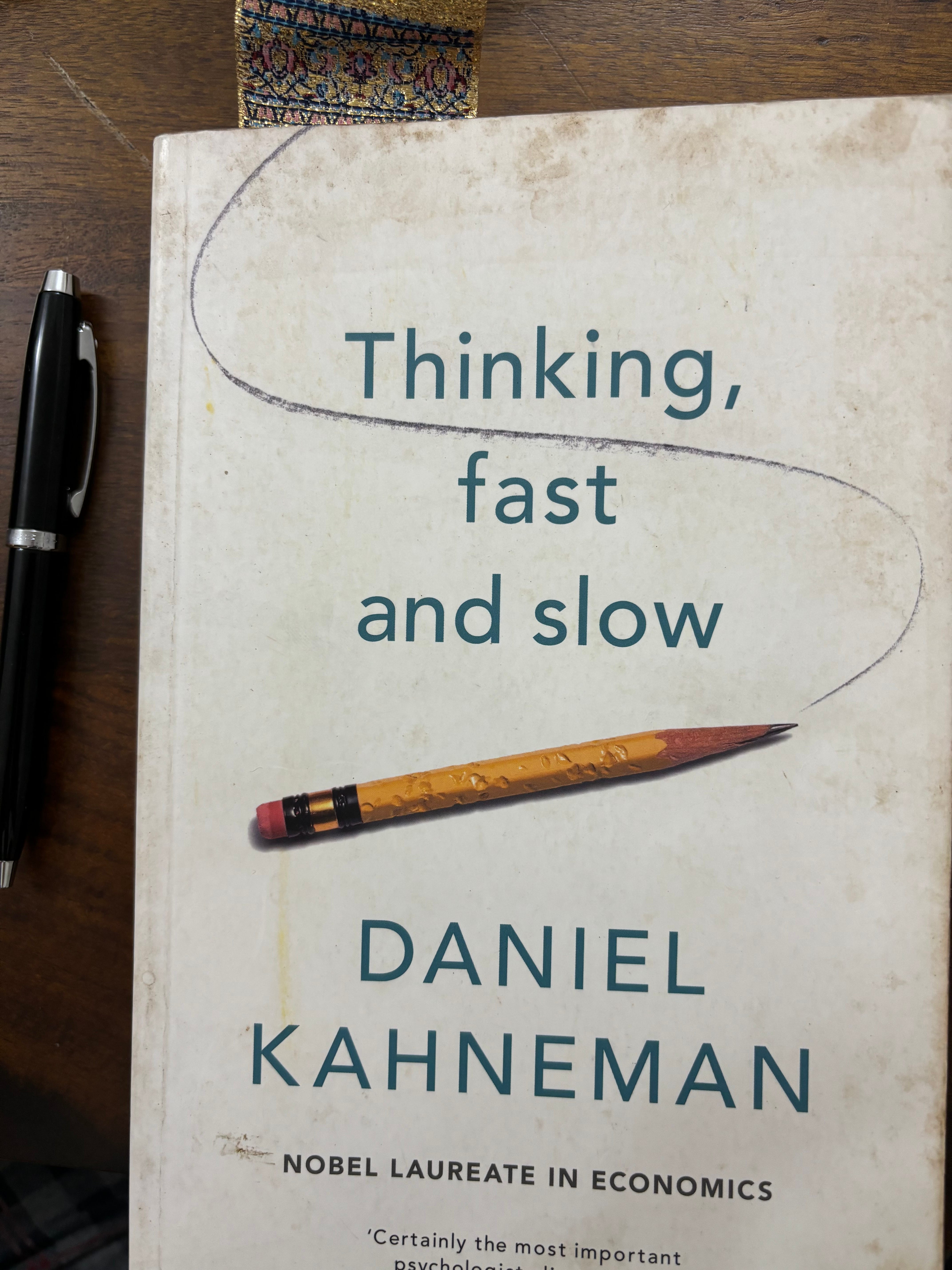
This book can’t be summarised and can only be expanded.
Thinking Fast and Slow summarises Kahneman’s ( and Amos Tversky's) decades of research on the psychological basis of our reactions, judgements, perceptions, and choices. The only way to learn from this book is to “slow read” it, as it is the densest book I have ever read.
A few quotes from the book that I can’t forget
"Acquisition of skills requires a regular environment, an adequate opportunity to practice, and rapid and unequivocal feedback about the correctness of thoughts and actions.”
"When people believe a conclusion is true, they are also very likely to believe arguments that appear to support it, even when these arguments are unsound.”
"A simple rule can help: before an issue is discussed, all members of the committee should be asked to write a very brief summary of their position. This procedure makes good use of the value of the diversity of knowledge and opinion in the group." (he thought about diversity long back)
My favourite chapter is the last one, “Thinking about Life.”. The chapter is almost philosophical. And the profound statement from the chapter
"Nothing in life is as important as you think it is when you are thinking of it.”
His last book with Oliver Sibony and Cass Sunstein was “Noise.” It deals with the world of human judgment and decision-making, specifically focusing on the influence of "noise", the random errors that distort our judgments and lead to suboptimal choices.
If you are wondering how it differs from Biases, here is a bit about the book.
As a leader, you want to make accurate decisions for your company. But sometimes, random factors (noise) or personal preferences (bias) can get in the way.
Noise is like throwing darts at a dartboard and missing the bullseye due to random errors. It can make your decisions inconsistent.
Conversely, bias is like throwing darts at a tilted board, always missing the same way due to personal preferences. It can make your decisions unfair or inaccurate.
Key takeaway:
Noise: Focus on processes that reduce randomness in decision-making. This could involve using explicit criteria, having multiple people review decisions, or taking time for reflection before making a final call.
Bias: Identify and address your own and your team's biases. Encourage diverse perspectives and use data to challenge assumptions.
A few quotes
“Judgment is not a synonym for thinking, and making accurate judgments is not a synonym for having good judgment.”
“When the facts change, I change my mind. What do you do?”
“It is more useful to pay attention to people who disagree with you than to pay attention to those who agree.”
An article that I can’t stop sharing with my coaching clients on decision making, written by him-here it is
A must listen podcast that Danny Kahneman did with Adam Grant, I have listened to it multiple times. Every sentence in this podcast is meaningful. Among many things, he spoke about intuition, happiness, and positive psychology. Here is the link.
Am quoting his observations on Positive Psychology and changing mind here-
“I think the positive psychology movement has, in some ways, a deeply conservative position, that it says let's accept people's condition as it is. And let's make people feel better about their unchanging condition. You know, there has been some critique of positive psychology along those lines. I'm not, uh, I'm not innovating here. But I think that focusing on changing circumstances and dealing directly with misery is more important, and is a worthier objective for society, than making people feel better about their situation.”
“I mean, I've really enjoyed changing my mind because I enjoy being surprised and I enjoy being surprised because I feel I'm learning something.”
Books
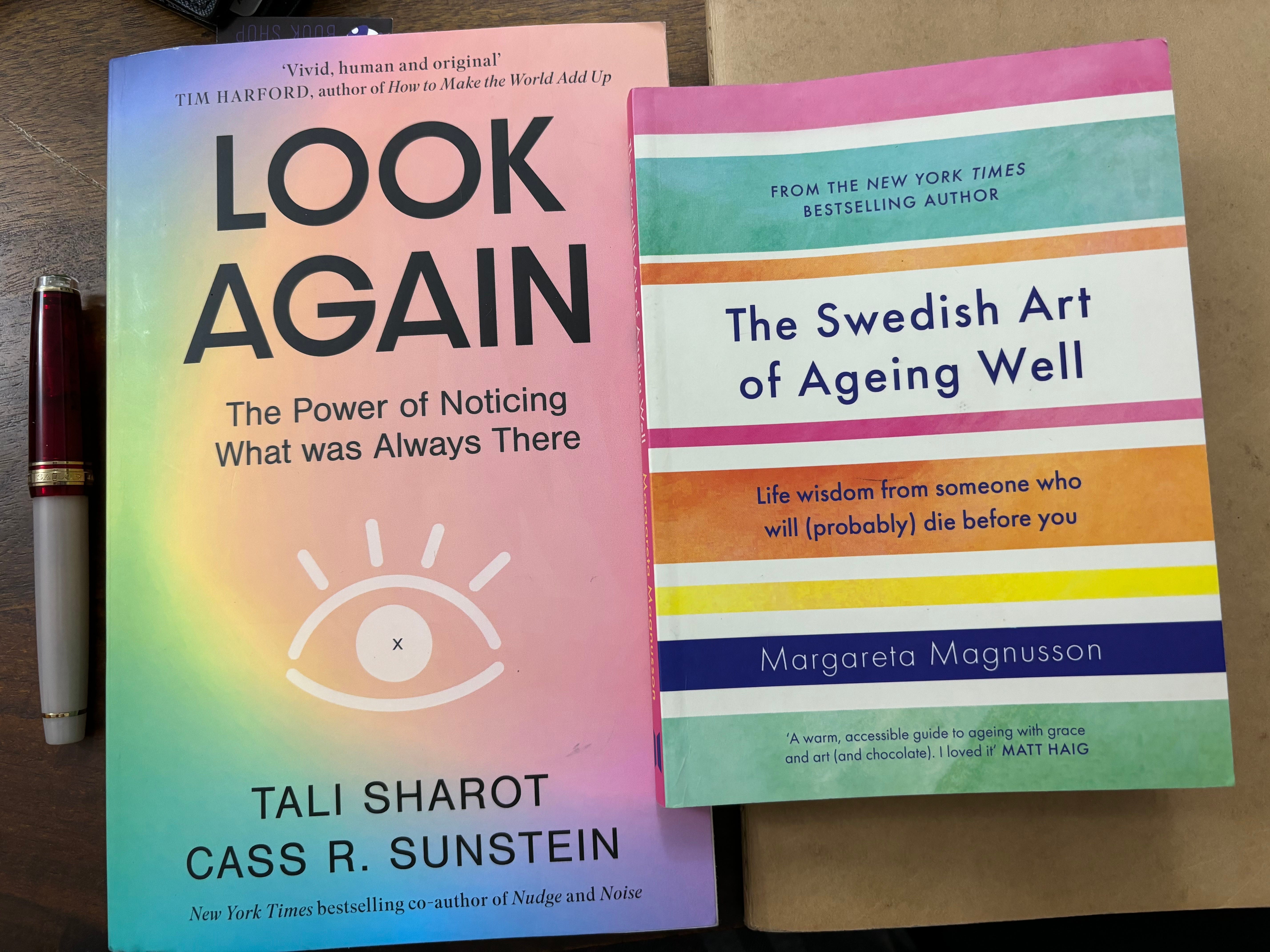
A book that made me think hard and pause is - Look Again by Tali Sharot and Cass Sunstein. It talks about why people become desensitised to both positive and negative aspects of life because of habituation. It is not a self-help book; it is a self-awareness book. It presents data and facts and leaves it there for you to decide how to use them.
Habituation is our brain’s tendency to respond less and less to things that are constant or change gradually. You walk into a biscuit factory (I have experienced it myself), and after 20 minutes, you can’t smell butter anymore.
The authors used a conversational style and mixed data and story well. It is a page-turner, and I have made many notes in the corners of the pages.
“Habit and routine are anti aphrodisiacs. Desire butts head with habit and repetition.”
“It turns out that joy of giving habituates much more slowly than the joy of getting.”
“Change increases creative thinking and habituation reduces it.”
“Psychologists have a name for the tendency to believe repeated statements: the illusory truth effect. It is why many people believe that humans use only 10 percent of their brain and vitamin C can prevent the common cold.”
Example- How in autocratic countries, the PMs and Presidents make people believe “unfacts” by repeating them again and again by themselves and using sold-out media.
A passing mention of a concise book- The Swedish Art of Aging Well, by Margareta Magnusson. She wrote it in 2022 when she was 86. Let me tell you the headings of the first two chapters-
Have a Gin and Tonic with a friend.
The world is always ending.
Curious? Read it.
Podcast
What it’s like to be- A stand up Comedian, hosted by Dan Heath and joined by Chris Grace. It is a behind-the-scenes view of a stand-up comedian’s life, challenges, and ways of work. I could connect their reality with that of a facilitator. Chris Grace talks about how he checks the audience's pulse, responds when there is a dip in audience engagement, how vulnerability works and how the best jokes get unearthed during the gig “here and now”. Link
Article
My Favourite author Amy Edmondson’s interview on -What we get wrong about failure and how to fail well. Some great advice, like
A deeper understanding of human motivation realises that the best way to get excellence is not punish people when things go wrong.
By calling attention to uncertainty, you are helping people understand how much room they have to experiment, which is either very, very small or very high. So you’re intellectually clarifying the nature of the game we’re playing here.
Bonus
If you like guitar, check this out, and don’t forget to read the description. Here
So many interesting thoughts & rabbit holes we can keep going into! Keep writing Suva
This was such a fantastic read, Suva., yet again...everytime I come back here, some precious gems get unearthed......